01 — Payroll
Every figure traces back to a receipt.
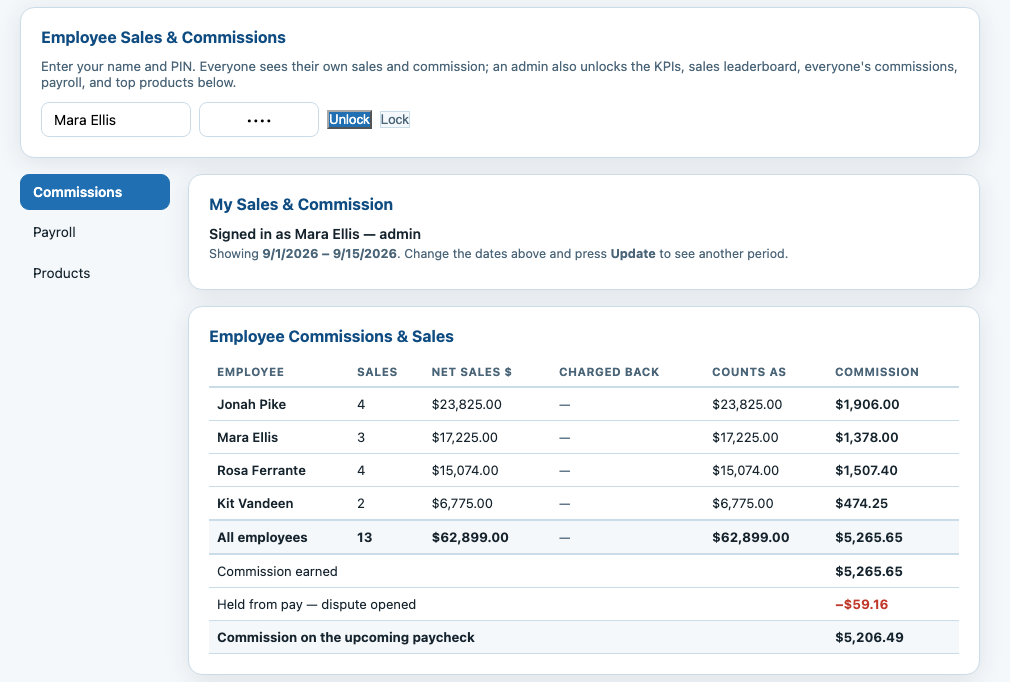
A commission run is arithmetic anyone can do and almost nobody can check. This one shows its working: click any total and the transactions inside it open — and every employee can check their own with their PIN, so the paycheck stops needing to be explained.
A SkySale customer
Fourteen hours of exporting a month, gone.
A cosmetic studio · three locations · shared staff
Commission payroll: 13 h a month back
| Where the time goes | Hours / month |
|---|---|
| Before · Exporting every studio’s sales and tracking each employee’s transactions across all three — 7 h a payday × 2 paydays | 14 h |
| With SkySale · Every employee’s sales across all three studios in one screen — review it and mark it paid — 30 min a payday × 2 paydays | 1 h |
| Back | 13 h |
The studio’s own figures. See all three jobs, and the 52.6 hours a month they add up to →
How a cheque is built
Six things happen between the sale and the payment.
- Sales are credited to people, not tills
- A sale can be split across several staff at percentages you choose, and the split is stored on the transaction — so a correction made later moves the commission with it rather than leaving the two to disagree.
- Each person has their own plan
- A flat rate, or a rate that changes above a threshold. Set per person, not per shop, because the person who sells the devices rarely earns the same as the person who sells the serums.
- Returns come off the cheque that paid them
- A return counts against the day the item sold. If the cheque that paid its commission is still open, it simply reduces net sales. If that cheque has already gone out, it becomes a visible deduction on the next one — once.
- Disputes are held, not lost
- Money in dispute comes off the open cheque and is remembered, so it can't be taken a second time. Won, it's released back. Lost, it stays gone. And a human can mark one as already settled elsewhere, which happens more than anyone would like.
- A shortfall carries, exactly once
- A cheque that lands below zero pays nothing, and the amount moves to the very next payday as a single carried line. Not by repeating the deductions behind it — that double-counts, and it is the single easiest way to underpay somebody by a thousand dollars.
- One person, one cheque
- Staff working across several shops have a record at each and a single payment. The shortfall is judged on the combined total, and marking them paid closes every record at once.
Who sees what
Staff see themselves. Managers see everyone.
- Name and PIN, every time
- Anyone can look up their own sales and commission at the till by entering their name and PIN. The screen re-locks when they leave it, so the next person can't read what the last one was looking at.
- Three roles
- Sales sees their own figures. Manager and admin see the full roster, the payroll run and the reports behind it.
- Paydays are yours
- Semi-monthly on the 1st and 15th, fortnightly, or whatever you already run — each payday covering the period that closed before it, in arrears.
Get in touch
Bring us your messiest pay period.
Walk through a fortnight you've already run — returns, disputes, split sales and all — and see whether the numbers come out where you put them.